

Diagnostic Ultrasound
Diagnostic Ultrasound
What Is Diagnostic Ultrasound?
Diagnostic ultrasound, also known as musculoskeletal sonography, is a non-radiation imaging technology that uses high-frequency sound waves to visualize soft tissues, joints, tendons, ligaments, and fluid collections in real time. Unlike MRI or CT scans, ultrasound provides immediate, dynamic visualization without exposure to ionizing radiation.
At Victory Over Pain, diagnostic ultrasound plays a central role in both evaluation and treatment planning. Because it allows direct visualization of tissue structures during movement, it helps identify inflammation, tendon degeneration, joint effusion, partial tears, and structural irregularities that contribute to chronic pain.
Rather than relying solely on static imaging reports, ultrasound enables live structural assessment at the point of care.
How Diagnostic Ultrasound Supports Clinical Used
Chronic musculoskeletal pain often originates from soft tissue degeneration rather than complete structural rupture. Ultrasound allows visualization of tendon thickening, fiber irregularity, synovial inflammation, joint effusion, and areas of scar tissue formation that may not appear clearly on standard radiographs.
Because imaging occurs during the consultation, findings can be directly correlated with a patient’s pain pattern. For example, shoulder movement can be assessed dynamically to evaluate rotator cuff function and impingement. Knee evaluation may reveal joint fluid accumulation or tendon degeneration contributing to instability.
This immediate structural insight helps determine whether conservative care, shockwave therapy, platelet-rich plasma (PRP), or stem cell therapy may be appropriate.
Ultrasound-Guided Regenerative Procedures
In addition to diagnostic value, ultrasound enhances procedural precision. When performing regenerative treatments such as PRP or stem cell therapy, real-time ultrasound guidance allows visualization of needle placement directly into the targeted tissue.
This improves both safety and accuracy by avoiding surrounding nerves and vascular structures while ensuring biologic material is delivered precisely to areas of degeneration or inflammation. Rather than relying solely on surface anatomy landmarks, ultrasound confirms proper placement within tendon insertions, joint spaces, or ligament attachments.
Image-guided injection techniques are widely recognized for improving procedural reliability and treatment consistency.
What Conditions May Be Evaluated for Diagnostic Ultrasound?
Diagnostic ultrasound may be used as part of structural evaluation in orthopedic, pain-related, and wound-related conditions. Imaging selection depends on clinical findings, symptom duration, and treatment planning considerations.
Orthopedic Issues
Diagnostic ultrasound may assist in evaluating:
Shoulder Conditions
Shoulder Pain
Rotator Cuff Tear
Shoulder Degeneration
Labral Injury (superficial components)
Shoulder Impingement
Knee Conditions
Knee Pain
ACL and MCL Injuries (partial or chronic changes)
Meniscus Irritation
Knee Osteoarthritis
Hip Conditions
Hip Pain
Hip Labral Tear (limited superficial assessment)
Hip Osteoarthritis
Elbow Conditions
Elbow Pain
Tennis Elbow (Lateral Epicondylitis)
Golfer’s Elbow (Medial Epicondylitis)
Foot & Ankle Conditions
Plantar Fasciitis
Achilles Tendinitis
Ankle Instability
Spine Conditions
Facet Joint Syndrome
Chronic Low Back Pain (soft tissue–related)
Neck Pain
Pain Issues
- Myofascial Pain Syndrome
Chronic Joint Pain
Tendinopathy
Ligament Injury Pain
Persistent Post-Surgical Joint Pain
Wound Healing
- Chronic Wounds
Diabetic Foot Ulcers
Venous Leg Ulcers
Post-Surgical Wounds
Non-Healing Incisional Wounds
Ultrasound may help evaluate soft tissue integrity, fluid collection, and vascular response in compromised tissue environments.
What to Expect During an Ultrasound Examination
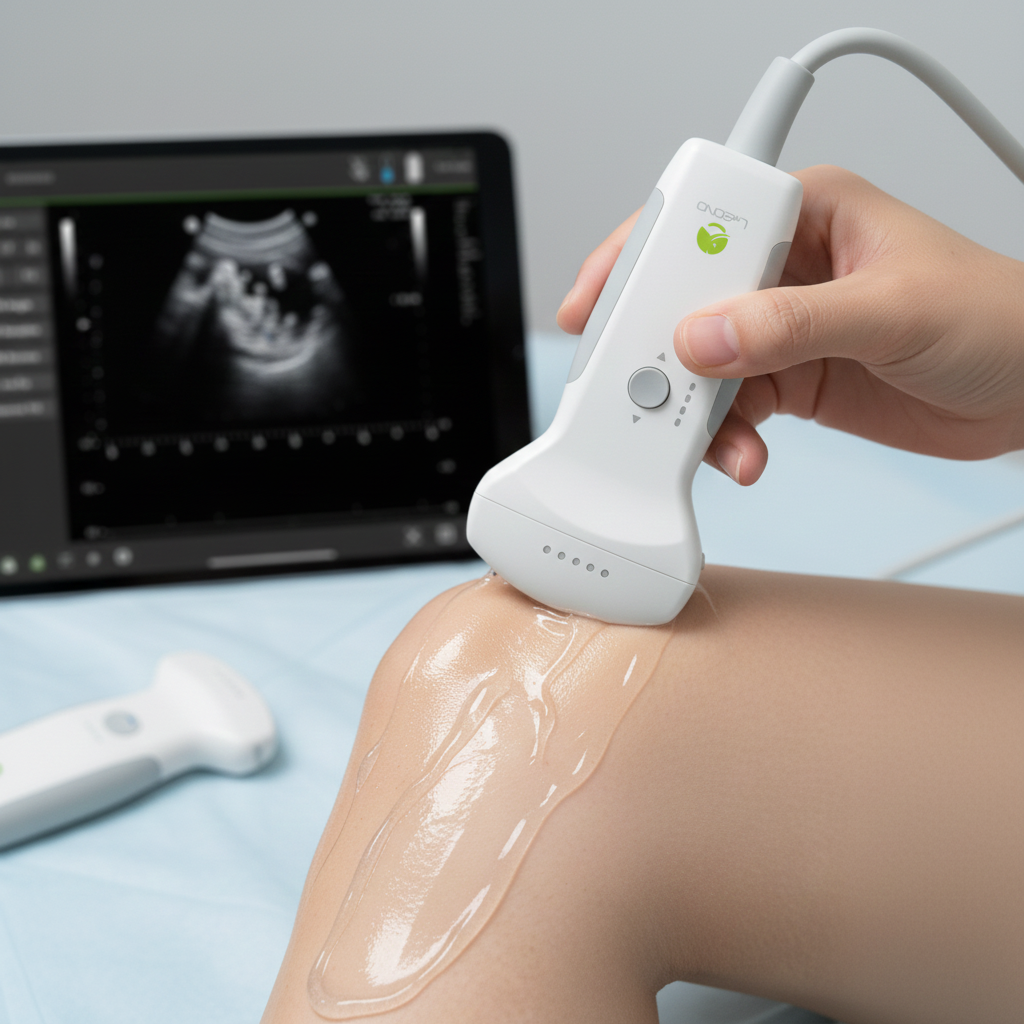
Diagnostic ultrasound is performed in-office using a handheld transducer placed over the area of concern. A conductive gel is applied to allow sound wave transmission. The examination is painless and typically completed within minutes.
Because ultrasound provides immediate imaging, results are reviewed during the consultation. This allows direct discussion of structural findings and treatment options without delay.
Unlike MRI or CT, ultrasound can be safely repeated as needed without radiation exposure.
Diagnostic Ultrasound Compared to Other Imaging Modalities
MRI remains valuable for deep structural evaluation; however, ultrasound offers several advantages in musculoskeletal care. It allows dynamic movement assessment, immediate bedside imaging, and procedural guidance.
For superficial tendons and ligaments, ultrasound often provides excellent resolution while remaining cost-effective and accessible. It is especially useful for evaluating chronic soft tissue conditions and guiding regenerative procedures.
Important Considerations Before Imaging
Not every orthopedic condition requires ultrasound evaluation. The decision to perform imaging depends on clinical examination findings, symptom duration, and treatment planning considerations.
Diagnostic ultrasound does not replace MRI in all scenarios, particularly in deep intra-articular pathology. A comprehensive consultation determines whether ultrasound imaging is appropriate for your condition.
SCHEDULE A CONSULTATION
Request a Physician Evaluation
Submit your information to connect with a participating physician in your region to determine whether regenerative therapy may be appropriate for your condition.